
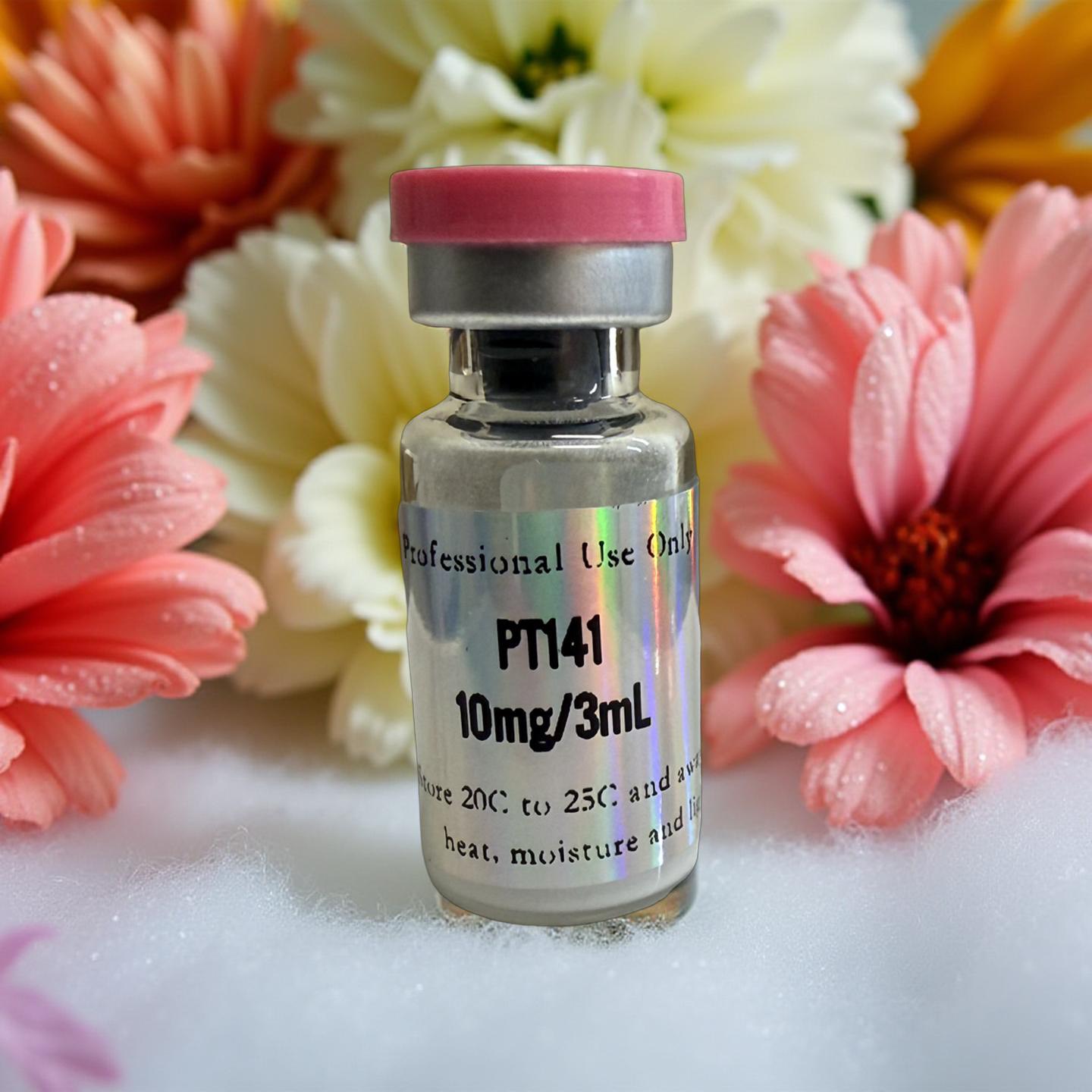
PT141
$80.00
PT-141 Overview – A Unique Melanocortin-Based Peptide
PT-141, clinically known as Bremelanotide, is a synthetic peptide and pharmacological agent derived from alpha-melanocyte-stimulating hormone (α-MSH). Unlike its parent compound, it has been structurally modified to enhance receptor selectivity and stability.
Mechanism of Action:
PT-141 acts primarily as an agonist of the melanocortin-4 receptor (MC4R) and, to a lesser extent, the melanocortin-1 receptor (MC1R). Activation of MC4R in the central nervous system is linked to sexual arousal pathways, while MC1R contributes to pigmentation and immune regulation.
Therapeutic Applications:
The peptide has been evaluated extensively for the treatment of hypoactive sexual desire disorder (HSDD) in both men and women. Unlike phosphodiesterase-5 inhibitors (e.g., sildenafil), which act on the vascular system, PT-141 influences neurogenic pathways of sexual desire and arousal. Clinical studies have also explored its use in acute hemorrhagic conditions due to its hemodynamic effects.
PT- 141 : Structure
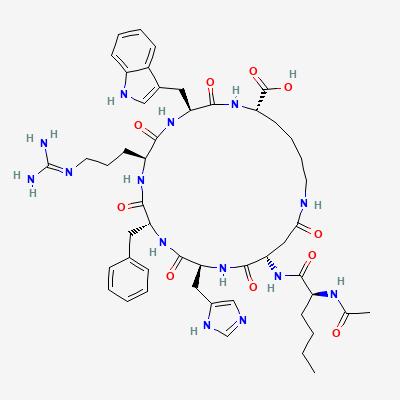
Peptide Sequence: Ac-Nle-Asp(1)-His-D-Phe-Arg-Trp-Lys(1)
Molecular Formula: C₅₀H₆₈N₁₄O₁₀
Molecular Weight: 1025.182 g/mol
PubChem CID: 9941379
CAS Number: 189691-06-3
Source: PubChem
Research-Grade Bremelanotide (For Laboratory and Scientific Use Only)
PT-141 is structurally derived from α-MSH, a naturally occurring neuropeptide involved in pigmentation regulation, inflammatory response, energy expenditure, and behavioral signaling. These intrinsic biological roles make PT-141 a notable candidate for studies examining:
Neuroendocrine processes
CNS-driven behavioral patterns
Stress and reward system interactions
Melanocortin receptor signaling
Peptide structure-function relationships
Receptor affinity and dose-dependent dynamics
Because it functions as an agonist at MC4R and MC1R receptors, PT-141 stands apart from peptides that primarily influence peripheral systems. Its neurological activity opens doors for research focusing on how the melanocortin pathway contributes to behavioral and physiological regulation in experimental models.
Key Research Insights and Laboratory Applications
1. Direct Interaction with Melanocortin Receptors
PT-141’s selective receptor affinity allows researchers to examine the role of MC3R and MC4R receptors in modulating behavioral and neuroendocrine responses. These receptors have been linked to appetite regulation, energy balance, motivational signaling, and stress-related pathways.
Laboratory exploration often involves:
Mapping receptor binding profiles
Assessing CNS response patterns
Evaluating melanocortin system activation
Observing changes within neural circuits in research models
2. Not a PDE-5 Modulating Compound
PT-141 differs from phosphodiesterase type-5 (PDE-5) modulators traditionally used in cardiovascular or vascular dilation research. Instead of altering blood flow or vascular pressure, PT-141 influences signaling pathways within the brain, enabling researchers to:
Study central arousal mechanisms
Observe dopamine-linked neural responses
Explore alternative pathways affecting motivation or behavioral outcomes
Investigate CNS-mediated peptide activity without vascular interference
This distinction is a primary reason PT-141 is widely utilized in studies aiming to isolate brain-based signaling from cardiovascular variables.
3. Research Potential Across a Broad Range of Scientific Fields
Studies often involve experimental subjects or in-vitro models to analyze:
Neuroendocrine dysfunctions
Behavioral response modulation
Stress-induced neural changes
Hormonal pathway interactions
CNS mapping related to arousal or motivation mechanisms
Because of its strong receptor-based selectivity, PT-141 is frequently incorporated into experimental setups evaluating dose responsiveness, receptor desensitization, cross-pathway interactions, and behavioral shifts.
4. Research-Grade Purity and Stability
PT-141 10mg is typically provided as a lyophilized powder, allowing researchers to benefit from:
Extended stability
Consistent sample integrity
Controlled reconstitution
Precision when designing dose-dependent protocols
Advanced lyophilization, purification, and packaging techniques help maintain peptide quality, supporting reproducible data collection and experimental reliability.
How PT-141 Is Utilized in Scientific Research
In controlled laboratory studies, PT-141 is examined for:
CNS activity mapping
Behavioral response testing
Receptor pathway signaling
Melanocortin system investigation
Endocrine and neurochemical interaction profiling
Dose-response and receptor affinity analysis
Structure-function characterization
Many experimental designs focus on observing how PT-141 influences neural pathways, peptide-receptor dynamics, and behavioral outcomes in research subjects, while ensuring all studies follow proper laboratory safety and handling protocols.
Why Laboratories Choose Licensed Peptides for PT-141 10mg?
Licensed Peptides provides research facilities with PT-141 prepared under strict quality standards to support experimental reliability. Operating within the United States, the company offers:
High research-grade purity
Secure, U.S.-based storage and handling
Professional packaging to protect vial integrity
Fast and reliable order fulfillment
A smooth procurement process via secure online checkout
Support for major credit and debit card transactions
Facilities selecting Licensed Peptides ensure timely availability of materials for ongoing scientific work, minimizing disruption to research schedules.
Frequently Asked Questions (Research-Focused Only)
1. What is PT-141?
PT-141 is a synthetic research peptide derived from α-MSH, provided in a 10mg lyophilized format for laboratory studies exploring melanocortin signaling, CNS responses, and behavioral pathways.
2. How is PT-141 different from PDE-5 pathway compounds?
PDE-5 modulators primarily influence vascular function. PT-141 interacts with melanocortin receptors within the brain, making it suitable for studying CNS-driven mechanisms independent of peripheral blood-flow variables.
3. What research fields commonly utilize PT-141?
Studies often involve:
Melanocortin receptor mapping
Behavioral neuroscience
Neuroendocrine signaling
Hormonal and neurochemical research
CNS pathway modeling
4. Does PT-141 influence cardiovascular metrics in research?
Its primary activity is CNS-based. Any cardiovascular observations in research subjects should be measured and documented according to laboratory protocol.
5. What form is PT-141 supplied in?
It is provided as a lyophilized peptide powder to support stability and controlled reconstitution for experimental use.
6. What is known about PT-141’s safety profile?
Safety information stems only from controlled research data. PT-141 is not approved for human or animal use and should be handled exclusively in laboratory environments using established safety procedures.
7. How long does PT-141 take to show measurable effects in research subjects?
Research data suggest measurable responses within several hours, depending on dosage, model type, method of administration, and experimental parameters.
8. How long do observed effects last in experimental models?
In research environments, effects may extend from 24 to 72 hours, with variation based on the subject model, receptor activity, and experimental design.
9. Does PT-141 accumulate in research subjects over time?
Research suggests no significant long-term buildup. Observed effects typically dissipate naturally over several days.
10. Can PT-141 be used alongside other peptides in studies?
Some experiments involve studying PT-141 in combination with other compounds affecting mood, hormonal pathways, or neurochemistry. All combined-compound studies must follow careful protocol design.
11. Does PT-141 affect sensitivity or behavioral enhancement in research subjects?
Some studies report heightened behavioral responses or CNS activation markers, though results vary depending on experimental conditions and model species.
12. Why PT-141 is considered distinct among research peptides?
Its direct CNS-targeted mechanism sets it apart from peptides that influence peripheral pathways, making it particularly valuable for investigations centered on neurological and behavioral regulation.
13. What does LPS-free peptide mean for PT-141 research?
An LPS-free peptide indicates that PT-141 has been processed to minimize lipopolysaccharide contamination, which is essential for laboratory studies where immune activation or assay interference must be avoided.
14. Why is PT-141 classified as an Endotoxin-free peptide?
As an Endotoxin-free peptide, PT-141 meets stringent purity thresholds designed for research settings that require reduced inflammatory artifacts, supporting cleaner and more reliable experimental observations.
15. Are research peptides endotoxin tested for this product?
Yes. PT-141 10 mg is supplied as research peptides endotoxin tested, ensuring quality verification prior to use in receptor analysis, signaling pathway studies, and other controlled laboratory experiments.
16. Why is a high-purity formulation important for PT-141 research?
A High Purity PT-141 formulation supports reproducibility and accuracy in experimental design by reducing the presence of synthesis byproducts that could interfere with melanocortin receptor interactions or CNS-focused research outcomes.
PT-141 : Research
PT-141 (Bremelanotide) and Sexual Arousal
PT-141 (bremelanotide) is a synthetic peptide that functions as an agonist of the melanocortin-4 receptor (MC4R), a receptor known to regulate sexual arousal within the central nervous system. Preclinical studies in animal models have demonstrated that MC4R activation enhances sexual motivation and increases copulatory behavior in both male and female subjects.
Unlike phosphodiesterase type 5 (PDE5) inhibitors such as sildenafil (Viagra), which primarily act on peripheral vascular pathways to improve penile blood flow, PT-141 acts centrally through neuroendocrine mechanisms. This distinction enables PT-141 to address sexual arousal disorders in men and women that are not attributable solely to vascular insufficiency.
Clinical research further supports its potential: in a study involving men with erectile dysfunction (ED) unresponsive to sildenafil, approximately one-third achieved satisfactory erections for sexual intercourse following administration of intranasal PT-141. The study also revealed a clear dose-dependent relationship, reinforcing the efficacy of PT-141 in selected cases.
These findings suggest that PT-141 may provide therapeutic benefit for both erectile dysfunction resistant to PDE5 inhibitors and central causes of hypoactive sexual desire, highlighting its unique role as a centrally acting treatment for sexual dysfunction.
PT-141 and Infection
Preclinical research indicates that activation of the melanocortin-1 receptor (MC1R), which is one of the receptor targets of PT-141, demonstrates notable antifungal and anti-inflammatory properties in a rat model of fungal infection. This finding is significant because currently available antifungal agents are limited by their mechanisms of action and are frequently associated with serious, treatment-limiting adverse effects. The identification of alternative therapeutic pathways, such as those mediated by MC1R activation, could therefore represent an important advancement in managing fungal infections. Such an approach may ultimately reduce morbidity and mortality, particularly in immunocompromised populations, where fungal infections are often severe and difficult to treat.
Referenced Citations
ALL ARTICLES AND PRODUCT INFORMATION PROVIDED ON THIS WEBSITE ARE FOR INFORMATIONAL AND EDUCATIONAL PURPOSES ONLY.
The products available on this website are intended solely for in-vitro research purposes (Latin: “in glass”), meaning they are used in experiments conducted outside a living organism. These products are not medicines or drugs, have not been evaluated or approved by the U.S. Food and Drug Administration (FDA), and are not intended to diagnose, treat, cure, or prevent any disease or medical condition. Any administration to humans or animals, whether by ingestion, injection, or other means, is strictly prohibited by law.
We take pride in providing every client, whether large or small, with dedicated and respectful service.