
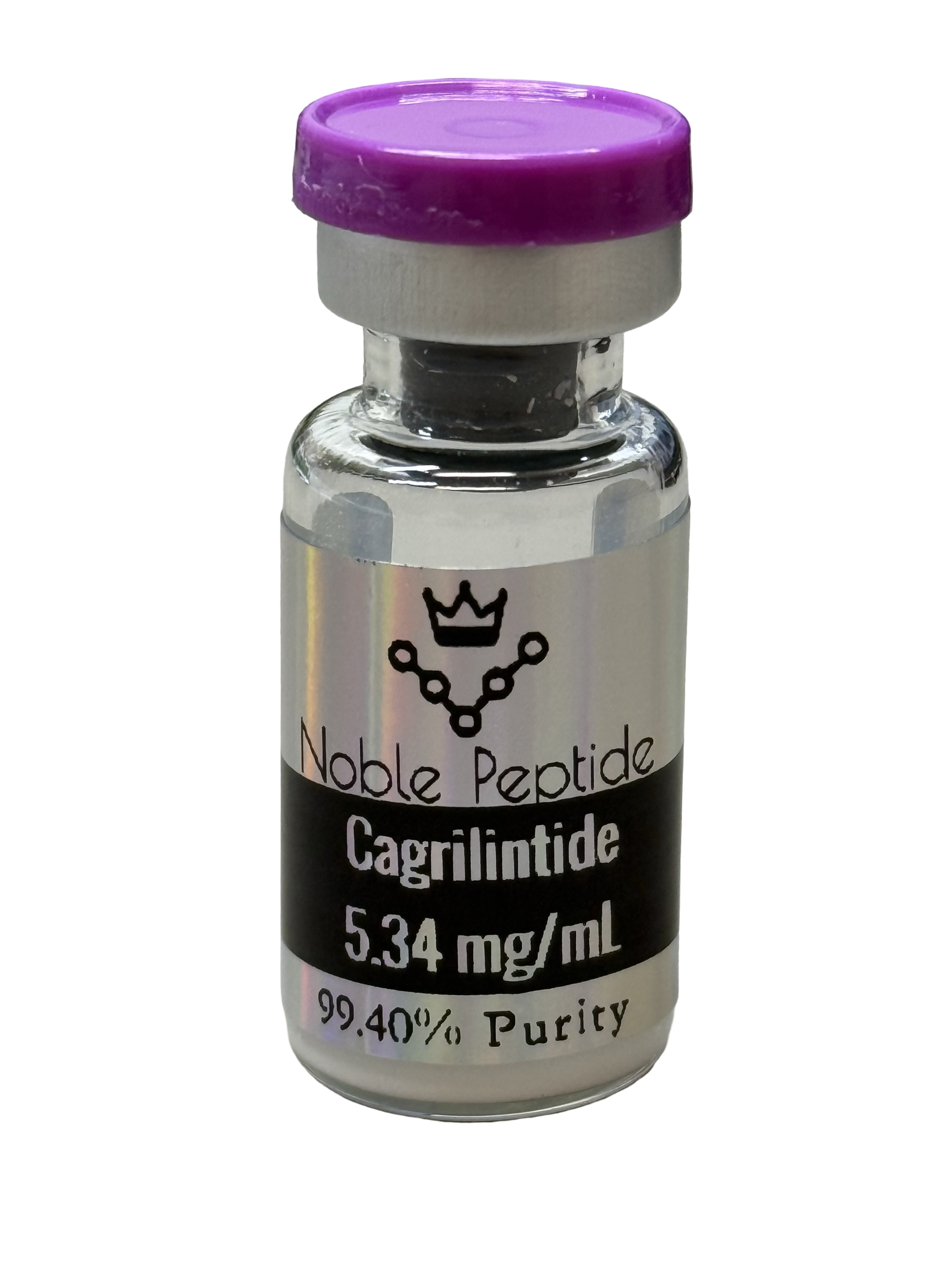
Cagrilintide 5mg
$140.00
Cagrilintide Overview:
A Research-Focused Overview of an Emerging Amylin Analogue
Cagrilintide is a long-acting analogue of amylin, a hormone that is naturally secreted alongside insulin. It has demonstrated potential in preclinical and clinical studies as a therapy for obesity and type 2 diabetes. Beyond these conditions, cagrilintide has been explored for its possible benefits in liver disease (including alcohol-related liver damage), as well as cardiovascular disorders. There has also been early speculation about a role in Alzheimer’s disease, although no published studies have yet confirmed this.
Much of the current research has focused on combining cagrilintide with semaglutide for the treatment of obesity and type 2 diabetes. This combination appears to act synergistically, producing greater and more sustained weight loss compared to either agent alone.
A Smarter Path to Understanding Appetite Regulation – From a Research Perspective
Cagrilintide has gained attention within the scientific community due to its ability to interact with amylin receptors, which play a role in satiety signaling systems. In controlled experiments involving research subjects, the peptide has demonstrated the capacity to influence food intake behaviors, regulate meal patterns, and modulate metabolic markers.
Key Areas of Research Interest
Studies to date have explored its potential applications in the following areas:
Appetite signaling pathways
Metabolic regulation mechanisms
Energetic balance and expenditure in research subjects
Combination therapy models, especially with GLP-1 receptor agonists
Preclinical liver function models
Alcohol-related liver disease research
Cardiometabolic research scenarios
Though there has been speculative discussion around its possible role in neurodegenerative research, such as Alzheimer’s disease, no published clinical-trial data currently exist in this area, and such concepts remain theoretical until supported by formal studies.
Cagrilintide: Structure

Molecular formula: C₁₉₁H₂₉₄N₅₂O₅₈S₂
Molecular weight: ~ 4226.8 g/mol
Peptide length: 37 amino acids
Disulfide bonds: 1 (between Cys² and Cys⁷)
Modification: Lipidation at Lys²⁸ via γ-glutamic acid linker and C16 fatty diacid
Type: Long-acting amylin analogue (peptide drug)
Half-life: ~8 days (due to lipidation and albumin binding)
Source: PubChem
Why Cagrilintide Stands Out in Research Settings
Below is a revised, research-oriented version of your key value points, carefully framed to avoid any implication of human use or benefit.
1. Strengthening Natural Satiety Signals in Research Models
Cagrilintide’s ability to mimic amylin has allowed researchers to observe its influence on satiety pathways in various controlled environments. By engaging amylin receptors, it appears to enhance natural fullness cues measured in research subjects. This provides investigators with valuable data on how hormonal signals interact with feeding behavior.
2. Supporting Research into Sustainable Weight-Regulation Models
Rather than forcing abrupt metabolic changes, Cagrilintide has shown gradual and sustained effects in preclinical and early clinical research subjects. These controlled observations offer insight into the long-term modulation of weight-related pathways.
3. Reduction of Cravings and Food-Seeking Behavior in Research Subjects
Research models consistently show that Cagrilintide can influence gastric emptying rates and glycemic patterns, which in turn affect food-seeking behaviors. These findings help scientists better understand the role of satiety hormones in behavioral feeding dynamics.
4. Complementary Effects with GLP-1 Research Agents
One of the most notable discoveries in metabolic research is the potential synergy between Cagrilintide and GLP-1 agonists, such as semaglutide. Studies indicate that these compounds may have complementary mechanisms, offering a dual-pathway model for investigating appetite regulation.
5. Potential Metabolic-Health Implications in Research Subjects
Though still in early investigation, some controlled studies have observed improvements in research markers such as:
Postprandial glucose responses
Insulin sensitivity indicators
Food-reward and binge-pattern reduction
These findings remain strictly confined to research settings and cannot be extrapolated to human outcomes.
6. Once-Weekly peptide profile
Cagrilintide’s extended activity window allows researchers to examine long-duration receptor activation and its effects on appetite-related biomarkers within structured laboratory timelines.
How It Works – Research Mechanism of Action
In scientific terms, Cagrilintide’s function begins with its activation of amylin receptors, including the calcitonin receptor complexes found in brain regions tied to appetite monitoring. These interactions have been observed to produce:
Reduced food-intake behavior
Altered reward-related feeding signals
Enhanced satiety cues
Modulated metabolic rhythms
Again, these outcomes pertain to research subjects only, forming the basis of experimental inquiry into metabolic regulation.
Appropriate Research Contexts for Cagrilintide
Cagrilintide may be relevant for laboratories or investigators who study:
Appetite signaling mechanisms
Overeating and reward-center activation in research subjects
Hormonal pathways related to feeding regulation
Combination-therapy metabolic models
Hormone-based energy-balance frameworks
These uses apply strictly to research environments and do not constitute guidance for human or veterinary use.
Why Choose Licensed Peptides for Cagrilintide Research Material?
Licensed Peptides provides research-grade Cagrilintide to U.S.-based laboratories operating under appropriate regulatory frameworks. Every vial is handled with care to protect peptide stability throughout the fulfillment process.
High-quality research peptides
Competitive pricing for scientific institutions
Secure online ordering supporting major cards
Prompt shipping within the United States
Professional, protective packaging for sensitive research materials
All materials are clearly labeled FOR RESEARCH PURPOSES ONLY — NOT FOR HUMAN OR ANIMAL USE.
Frequently Asked Questions (Research-Only FAQ)
1. What is Cagrilintide?
Cagrilintide is an investigational amylin-receptor agonist studied for its potential roles in satiety signaling, metabolic regulation, and feeding-behavior research. It is used exclusively for laboratory research and is not intended for human or veterinary application.
2. How does Cagrilintide work in research models?
Studies show that Cagrilintide activates amylin pathways that regulate satiety signals. In research subjects, this results in measurable changes in feeding patterns, caloric intake, and appetite-related behaviors.
3. Is Cagrilintide the same as GLP-1 agents?
No. Cagrilintide targets the amylin receptor, whereas GLP-1 agonists target glucagon-like peptide-1 pathways. Their complementary mechanisms make them useful when evaluating combination models in metabolic research.
4. Does Cagrilintide reduce appetite in research subjects?
In controlled trials, Cagrilintide has been shown to influence satiety cues and reduce voluntary food intake in research subjects, making it valuable for appetite-regulation studies.
5. What is the primary research findings associated with Cagrilintide?
Findings include changes in satiety signaling, alterations in feeding rhythms, reduced food-seeking behavior, and modulated glucose-response patterns in research subjects.
6. How long does it take for effects to present in research models?
Many studies report observable appetite-related changes within 1–2 weeks in research subjects, though full pathway modulation appears over extended trial periods.
7. Can Cagrilintide be studied alongside GLP-1 agonists?
Yes. Research has demonstrated significant interest in combining Cagrilintide with GLP-1 agents to explore synergistic effects on metabolic and satiety pathways.
8. Does Cagrilintide affect blood-sugar patterns in research subjects?
Some studies indicate that Cagrilintide can influence post-meal glycemic markers and stabilize feeding-driven glucose oscillations in research models.
9. Is there evidence supporting its use in emotional-eating or reward-system research?
Cagrilintide appears to impact feeding reward-systems, making it useful for exploring binge-pattern behaviors or compulsive-eating models in laboratory research.
10. How long do the observed research effects last?
Due to its long receptor-activation profile, Cagrilintide exhibits extended effects in research subjects, enabling researchers to study longer cycles of metabolic signaling.
11. Are there side effects noted in research subjects?
As with most investigational hormones, some research models report effects such as nausea-like responses or altered feeding desire, which typically decrease as studies progress.
12. Is Cagrilintide appropriate for long-term research protocols?
Its extended-duration design makes it suitable for exploring long-term metabolic pathways, appetite regulation, and energy-balance studies in research subjects.
13. What does it mean that Cagrilintide is an LPS-free peptide?
An LPS-free peptide indicates that Cagrilintide has been tested to confirm the absence of lipopolysaccharides, which are bacterial endotoxins that can interfere with experimental outcomes. This is especially important for cellular, receptor, and signaling pathway research.
14. Why is endotoxin-free status important for research peptides?
Endotoxin contamination can activate unintended immune or stress responses in experimental systems. An endotoxin-free peptide helps ensure that observed effects are attributable to Cagrilintide itself rather than external contaminants.
15. Are Cagrilintide research peptides endotoxin tested?
Yes. Cagrilintide provided for research purposes is endotoxin tested, supporting consistency and reliability in sensitive laboratory applications, including in vitro and biochemical studies.
Cagrilintide: Research
What is Cagrilintide?
Obesity and type 2 diabetes are chronic, relapsing conditions that impose a major global health burden. Despite the success of glucagon-like peptide-1 receptor agonists (GLP-1RAs), many patients fail to achieve or sustain sufficient weight reduction with current therapies. Amylin, a peptide hormone co-secreted with insulin, has long been recognized as a target for weight and glycemic control due to its role in regulating satiety, gastric emptying, and postprandial glucagon secretion. However, the native hormone is unstable and prone to aggregation, limiting its therapeutic use.
Cagrilintide (NNC0174-0833) is a long-acting, acylated amylin analogue developed by Novo Nordisk. By combining the physiological actions of amylin with structural modifications that enhance stability and extend half-life, cagrilintide represents a new therapeutic approach for chronic weight management and type 2 diabetes.
Mechanism of Action
Cagrilintide is a 37–amino acid peptide structurally related to human amylin, modified with a C16 fatty diacid side chain linked via a γ-glutamic acid spacer at Lys²⁸. This lipidation promotes albumin binding, extending its plasma half-life to approximately one week, which allows for once-weekly dosing.
At the receptor level, cagrilintide activates amylin receptors, which are heterodimers consisting of the calcitonin receptor (CTR) combined with receptor activity-modifying proteins (RAMPs). Preclinical work has shown that cagrilintide’s weight-lowering effects are mediated primarily via AMY1 and AMY3 receptor subtypes, which are highly expressed in appetite-regulating regions of the brain. This results in reduced food intake, delayed gastric emptying, and improved satiety. Importantly, its mechanism is complementary to GLP-1 receptor agonists, making it an attractive candidate for combination therapy.
Clinical Development in Obesity
Phase 2 Studies
In a pivotal Phase 2 trial (Lancet 2021), adults with overweight or obesity were randomized to receive weekly injections of cagrilintide, liraglutide, or placebo for up to 68 weeks. Results demonstrated dose-dependent weight loss, with cagrilintide producing clinically meaningful reductions in body weight compared to placebo and, at certain doses, exceeding those achieved with liraglutide. The most common adverse events were gastrointestinal (nausea, vomiting), which were generally mild to moderate.
Phase 3 Studies
The REDEFINE-1 trial (NEJM 2025) investigated the fixed-dose combination of cagrilintide (2.4 mg) with semaglutide (2.4 mg), branded in development as CagriSema, in adults with obesity but without diabetes. After 68 weeks, participants in the combination group achieved an impressive 22.7% mean body-weight reduction (20.4% in the ITT analysis), compared to ~2–3% with placebo. A substantial proportion of participants achieved ≥20% or even ≥25% weight loss, magnitudes approaching those observed with bariatric surgery. Gastrointestinal events were the most frequent side effects, but overall tolerability was consistent with other incretin-based therapies.
Clinical Development in Type 2 Diabetes
Phase 2 Studies
A Phase 2 trial (Lancet 2023) assessed the combination of cagrilintide and semaglutide in patients with type 2 diabetes. The combination produced greater reductions in body weight and HbA1c compared to either agent alone or placebo, confirming the complementary nature of amylin and GLP-1 pathways.
Phase 3 Studies
The REDEFINE-2 trial (NEJM 2025) extended these findings to a larger cohort of adults with type 2 diabetes and obesity. After 68 weeks, CagriSema achieved average weight losses of 15–16% alongside clinically significant HbA1c reductions compared to placebo. Safety was dominated by gastrointestinal side effects during titration but was otherwise favorable, with no unexpected safety signals.
Summary
Cagrilintide is a next-generation, long-acting amylin analogue that represents a new therapeutic class in obesity and diabetes care. As monotherapy, it produces meaningful weight loss; when combined with semaglutide, the effects are among the strongest seen with injectable therapies, reaching weight-loss magnitudes previously associated with bariatric surgery. Its complementary mechanism and once-weekly dosing make it a promising candidate for long-term treatment of obesity, with or without type 2 diabetes.
Cagrilintide : Scientific Journal & Authors
Dr. Thomas Lutz studied veterinary medicine at the University of Berlin, FRG, and did his veterinary doctoral thesis at the University of Zurich on epithelial electrolyte transport. He completed a PhD at the University of Queensland in Brisbane, Australia, on the pathophysiology of feline diabetes mellitus. He became Professor in Veterinary Physiology at the University of Zurich in 2004. His research focuses on the neuroendocrine control of eating, the pathophysiology of obesity and on the pathophysiology of obesity-related comorbidities like type 2 diabetes mellitus. Linked to that is a specific focus on weight lowering therapy and multi-organ crosstalk.
Dr. Thomas Lutz is being referenced as one of the leading scientists involved in the research and development of Cagrilintide. In no way is this doctor/scientist endorsing or advocating the purchase, sale, or use of this product for any reason. The purpose of citing the doctor is to acknowledge, recognize, and credit the exhaustive research and development efforts conducted by the scientists studying this peptide.
Referenced Citations
Kruse T, Christoffersen BØ, Mortensen K, et al. Design and pharmacological characterization of cagrilintide (NNC0174-0833)… Journal of Medicinal Chemistry, 2021; 64(12):8942–8954. [View on Journal of Med Chem]
T.A Lutz, “Creating the Amylin Story”
ALL ARTICLES AND PRODUCT INFORMATION PROVIDED ON THIS WEBSITE ARE FOR INFORMATIONAL AND EDUCATIONAL PURPOSES ONLY.
The products available on this website are intended solely for in-vitro research purposes (Latin: “in glass”), meaning they are used in experiments conducted outside a living organism. These products are not medicines or drugs, have not been evaluated or approved by the U.S. Food and Drug Administration (FDA), and are not intended to diagnose, treat, cure, or prevent any disease or medical condition. Any administration to humans or animals, whether by ingestion, injection, or other means, is strictly prohibited by law.